
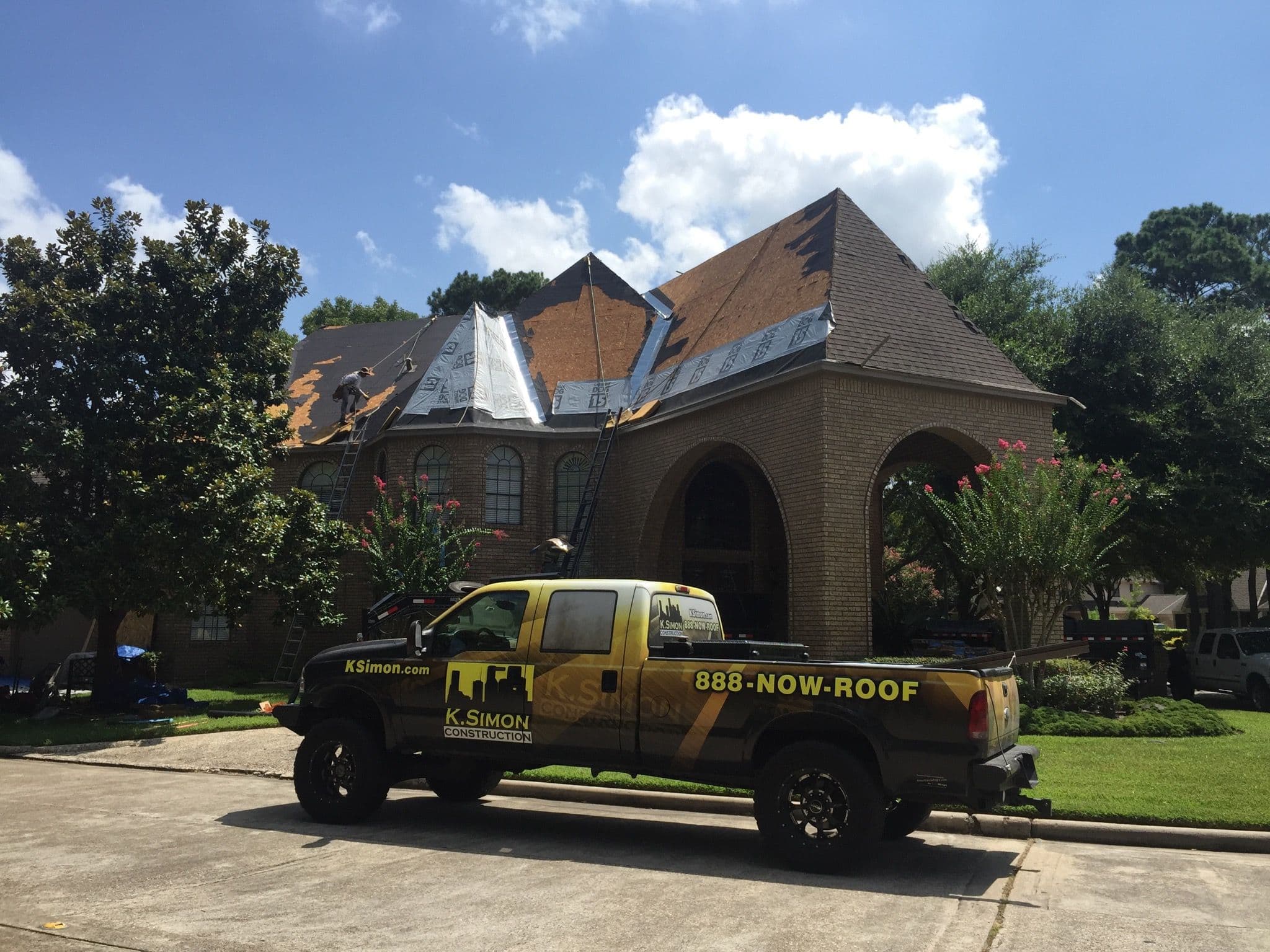
K. Simon Construction branded truck parked in front of a residential roof replacement in progress

Storm restoration

Storm restoration starts with what the storm actually did

After hail, wind, or a hurricane, the repair scope should come from documented damage on your roof, not from a pitch at your door. K. Simon inspects, documents, and puts the scope in writing before anyone talks about signing.

Water coming in right now? Go to emergency roofing. Safety steps first, then the emergency line.

Whose roof

This page covers both. Your next step depends on which.

What follows applies to any roof a storm hits. The steps to take today, and the proof that matters to you, split by who owns the building.

What you are dealing with

What hail and wind actually do to a roof

Storm damage behaves differently on every roof system, and much of it is invisible from the ground on the day of the storm.

Asphalt shingle

Hail
Impacts bruise the mat and dislodge the granule layer that shields it from UV. The leak often shows up months after the storm, not the day of it.
Wind
Gusts crease shingles and break the sealant bond between courses. A roof can be compromised with nothing visibly missing from the ground.

Metal panel

Hail
Dents are often cosmetic, but impacts at seams, fasteners, and coated surfaces can open paths for water or start corrosion under the finish.
Wind
Uplift works trim, ridge, and flashing loose at the edges first: small movements that grow with every storm after.

Single-ply membrane (TPO / EPDM)

Hail
Impacts can bruise or fracture the membrane (especially aged membrane, or membrane over a hard substrate), leaving punctures too small to spot from a distance.
Wind
Uplift concentrates at corners and perimeter, stressing the attachment and any seams in those zones.

Tile and slate

Hail
Impacts crack pieces outright or leave hairline fractures that fail later under foot traffic or freeze-thaw cycles.
Wind
Displaced or broken pieces expose the underlayment, which then becomes the only layer keeping water out.

This is how these systems behave in general. What your roof needs is determined by inspecting your roof. See roof systems for how each one is built.

Why it matters

Documentation comes before scope

A documented inspection produces dated photos tied to locations, measurements, and condition notes. That order (evidence first, scope second) changes what you can do with the result.

  • The scope is checkable

    Every line item traces to a photographed, located condition; you can see why it exists.

  • Bids become comparable

    A written scope lets you put a second opinion next to it, line for line.

  • Evidence, not persuasion

    Repair versus replace becomes an evidence question, not a persuasion question.

  • A dated record, yours

    You hold a dated record of the roof's condition, yours to use, including in any conversation with your insurer.

How the work runs

Inspect. Document. Explain. Build. Verify. Close out.

The same sequence every time, whether the outcome is a repair or a replacement. Each step produces something you keep.

  1. Inspect

    Start with conditions, constraints, access, and priorities.

  2. Document

    Create a record that supports a real scope and a real decision.

  3. Explain

    Compare repair, restoration, and replacement paths in plain language.

  4. Build

    Coordinate people, property protection, production, and communication.

  5. Verify

    Review critical details, progress, and completion evidence.

  6. Close out

    Deliver final records and a clear path for future service.

After a major storm

How to evaluate any contractor at your door

Big hail and wind events draw contractor attention to every affected property, some of it from crews that arrive with the storm and leave with it. Whoever you talk to, hold them to this list.

  • A permanent contact you can verify.

    A business presence you can find independently, a phone that will still answer next year, and a named person responsible for your project.

  • A written, itemized scope before you sign anything.

    Line items tied to documented damage on your roof, not a one-page “storm package” with a single price on it.

  • No same-day-signature pressure.

    A legitimate scope is still valid tomorrow. Pressure to sign on the spot (or to sign over control of your insurance claim at the door) is a reason to slow down, not speed up.

  • License and insurance you check yourself.

    Ask for the license number and the certificate of insurance, then verify them with the issuer. A logo on a truck is not verification.

  • A clear answer on what happens after the crew leaves.

    Who you call if something is wrong six months from now, and how problems found after completion get handled, in writing.

Apply the same list to K. Simon. A contractor confident in its scope has no reason to rush your signature.

Storm jobs on record

The documentation, on real storm jobs

Storm work from our own project records, with the client's details blacked out. Each page shows what was documented and what was built, and says nothing about how anyone's claim went.

Tile · Residential

Verea clay S-barrel re-roof, St. Petersburg, FL

System installed
Verea Clay S Barrel, Fume mix, over 2-ply self-adhered modified bitumen
Service line
Roof replacement, tile off and tile on
Market
St. Petersburg, FL
Scale
69 squares across 27 facets

Problem. Hurricane Milton damaged all 27 facets of this clay tile roof on October 9, 2024. The aerial measurement recorded 69 squares of tile, 407 feet of hips, and 161 feet of valleys.

Result. A Verea Clay S Barrel roof in the Fume mix over Polyglass MTS Plus and TU Plus, with 477 linear feet of mortar-bedded hips and ridges and 515 feet of clay bird stops. The Certificate of Completion was signed April 3, 2026.

Read the full case study

Shingles · Residential

Shingle roof and flooded interior rebuilt after a hurricane

System installed
TAMKO Titan XT laminated shingles, six nails each, over ice and water shield across the entire deck
Service line
Roof replacement and interior flood restoration
Market
Treasure Island, FL
Scale
43 squares ordered; 3,989 sq ft of deck re-nailed

Problem. On September 26, 2024, hurricane winds tore into the shingle roof of a single-story waterfront home and the same storm pushed flooding through the entire main level. Every room took water.

Result. TAMKO Titan XT shingles fastened with six nails each, mastic at the eaves, rakes, valleys, and gable ends, and the 224 feet of seamless gutters reinstalled intact rather than replaced. Inside: 568 linear feet of flood cut, 72 sheets of drywall, a rebuilt kitchen, ten new interior doors, new vanities and trim, and prime and paint through the whole home. The roof's Certificate of Completion was signed February 26, 2025.

Read the full case study

Insurance-funded restoration

Documentation built to be checked line by line

Insurance-funded storm restoration is a specialty at K. Simon, not a sideline, and the work product is built accordingly.

Dedicated storm teams perform deep-detail damage inspections: the roof is documented condition by condition, with dated photos tied to locations, measurements, and notes, not summarized from the driveway.

From that record we produce comprehensive, itemized repair and replacement estimates, written so that you, your insurer, or a second opinion can trace every line back to a documented condition on your roof.

Carrier-ready means checkable, not persuasive. The estimate describes the documented damage and what repairing or replacing it takes; what your policy covers stays between you and your insurer, as the next section states plainly.

Rather see it than read about it? Look through a real hail damage report, all 36 pages, with the client's details blacked out.

Where we stop

Construction is our decision. Insurance is yours.

We assess, document, scope, and build. Whether to file a claim, and what your policy covers, is between you and your insurer.

What our documentation gives you is a factual, dated record of the roof's condition and a written scope of work. If you choose to involve your insurer, that record speaks for itself.

What we will not do: predict coverage, promise a claim outcome, or build a scope around a settlement target instead of the documented condition of the roof.

After the storm

Find out what the storm actually did.

Request a documented storm inspection and get the roof's condition in writing: dated photos, findings, and a scope you can check line by line. Prefer to talk it through first? Call us.

Call now Inspection