Assembly
Deck or substrate, insulation, underlayment or membrane layers, attachment, and surfacing, specified as one assembly rather than a product name.
Long-life system · Roof system record
Crisp architectural lines with concealed fasteners and system-specific detailing.
Best-fit context
Panel profile, clip design, underlayment, thermal expansion, penetrations, and transitions determine performance. A metal roof is a system of moving parts; the details decide whether it lasts.
40-70 years typical industry range
Varies by climate, installation quality, detailing, and maintenance. A range starts the conversation; it is not a guarantee.
Deck or substrate, insulation, underlayment or membrane layers, attachment, and surfacing, specified as one assembly rather than a product name.
The conditions, measurements, and tests that determine whether this system actually fits the building.
Edges, penetrations, drainage, transitions, movement, and material compatibility: where roof performance is decided.
Photos, product records, inspection points, and maintenance guidance, delivered so the owner holds the evidence.
System anatomy
A standing seam roof is a system of moving parts. The panels are the visible half; the clips, seams, and underlayment are the half that decides whether it reaches its long life.
A solid, sound deck for architectural residential work. It carries the clips and gives the panels a continuous surface to sit over, which also quiets the roof in rain.
Metal runs hot, so the underlayment beneath it has to be rated for that heat. A self-adhered high-temperature membrane is common because it seals around the clip fasteners and backs up the panels against wind-driven rain.
The panels are held by clips fastened to the deck and hidden under the seams, so there are no exposed fastener holes in the field. On long panels the clips must let the metal expand and contract, or the roof fights its own thermal movement.
Coated steel or aluminum panels with raised, interlocking seams that stand above the water plane. The coating, usually a PVDF finish over a metallic-coated substrate, is what holds color and resists corrosion for decades.
The vertical ribs where panels join, either snapped together or mechanically folded. The seam type and how well it is engaged decide how the roof handles uplift and wind-driven rain, which is why it is the detail to ask about.
Ridge, hip, eave, rake, and valley trims, plus curb and pipe flashings with their sealed closures. These details, not the flat panels, are where a metal roof leaks if it leaks at all.
Listed from the deck up. On metal, the fasteners and seams you never see decide the roof's life, not the panels you do.
What it does well
Standing seam earns its cost over a long horizon. Its strengths come from what it does not have as much as what it does.
The fasteners are concealed under the seams, so the flat of the roof has nothing to back out or leak through. That single design choice is most of why standing seam outlasts an exposed-fastener metal roof.
Water and debris run off a smooth, sloped metal surface quickly, the assembly is noncombustible, and a properly clipped and seamed roof resists high uplift. That combination suits both long ownership and demanding exposures.
A quality PVDF paint finish keeps its color far longer than a lesser coating, so the roof looks intentional for decades rather than chalking and fading early. The metal itself typically outlives the finish.
Where it fails
Metal rarely rots or wears through in the field. When it disappoints, the cause is almost always movement, coating, or a detail.
Visible waviness in the flat of a panel, most obvious in low sun. It is cosmetic, not a failure, and striations or a ribbed profile reduce it, but owners who expect a mirror-flat roof are often surprised. Worth understanding before install, not after.
If the clips or fasteners pin a long panel so it cannot expand and contract, the metal buckles or works its fastener holes loose over the seasons. This is an installation error, and it is why floating clips exist.
Bare steel at a scratch or an unprotected cut edge can rust, and putting incompatible metals in contact, or letting runoff from one wash onto another, drives galvanic corrosion. At the coast this is the failure to watch, and it starts at the details, not the field.
Florida climate fit
Standing seam can be an excellent Florida roof, but the coast rewrites the material and detail choices. Salt, not weather-worn steel, is the enemy here.
Near salt air, aluminum or a high-grade coated steel with compatible fasteners and flashings holds up where a cheaper steel would streak and rust. Cut edges get protected, and dissimilar metals are kept apart. The right specification is a coastal decision, not a catalog default.
A standing seam roof with the right seam type, clip spacing, and product approval performs strongly in hurricane-zone wind. The approval and fastening schedule have to match the building's exposure, which is verified for the site rather than assumed from the brochure.
Florida sun makes reflective cool-metal finishes worth their cost for attic heat, and it makes thermal movement real, so floating clips on long runs are not optional. High-temperature underlayment is a given under metal here.
Maintenance rhythm
Standing seam is genuinely low-maintenance, which is different from maintenance-free. The little that it needs protects the decades it promises.
Once a year and after storms, look for scratches to bare metal, loose trims, and the condition of the sealant at penetrations and curbs. Touch up scratches promptly so a cosmetic mark does not become a corrosion spot.
Keep dissimilar metals, treated-lumber runoff, and debris piles off the panels, and rinse sheltered coastal areas that rain does not reach. Most metal corrosion is something the roof was allowed to sit in, not the metal giving out.
The sealant at boots, curbs, and transitions has a finite life shorter than the panels. Renewing it on the sealant's clock, rather than after a leak, is most of what long-term metal maintenance is.
Quality versus shortcut
The biggest quality gap in metal roofing is which product you were actually sold, followed closely by whether it was allowed to move.
The correct metal and coating for the exposure, floating clips that accommodate thermal movement, seams engaged as specified, high-temperature underlayment, compatible fasteners and flashings, and careful cut-edge protection at the coast.
An exposed-fastener panel sold as a standing seam roof, panels pinned so they cannot move, a lesser paint finish that chalks early, mismatched dissimilar metals, and details that lean on caulk instead of proper flashing and closures.
Ask whether the fasteners are concealed, whether the clips float, what coating and metal are specified, and how the roof handles expansion. Straight answers signal a system; vague ones signal a panel screwed down and called metal.
Repair or replace
A well-built standing seam roof rarely poses a whole-roof replace question for a long time. Its issues are usually finish and detail work.
Refastening a loose trim, renewing sealant at a penetration, touching up a scratch, or reflashing a curb are routine fixes on a roof whose panels are sound. Most metal service calls are details, not the field.
Late in life the finish is usually the limit, not the metal. A sound substrate can often be recoated or have panels addressed selectively, extending the roof rather than tearing it off.
Widespread corrosion, panels deformed by trapped movement, or a system whose seams never sealed properly can push past repair. Even then, the deck and structure usually carry a new metal roof without change.
How it ages
A rough picture of how a standing seam roof tends to move through its typical 40 to 70 year range. Coastal exposure, coating grade, and detailing move every stage.
Years 0-10
Finish is crisp and seams are tight. Any weakness tends to be an install detail surfacing early, which is why the first storm season is worth watching.
Years 10-25
Lesser coatings begin to chalk or fade slightly while a quality PVDF finish barely moves. The sealant at penetrations reaches its first renewal.
Years 25-45
The finish matures, a second sealant renewal comes due, and the occasional trim gets refastened. The panels themselves remain sound.
Years 45-70+
The finish, not the metal, becomes the life-limiter. Recoating or panel-by-panel work extends a roof whose substrate is often still serviceable.
These are general aging patterns for the system, not a schedule. Climate, installation quality, and maintenance move every date, which is why service life is written as a range.
This system, on a real roof
Jobs from our own project records that installed this system, with the client's details blacked out. The facts below come from measurement reports, material orders, and completion paperwork.
Metal · Residential
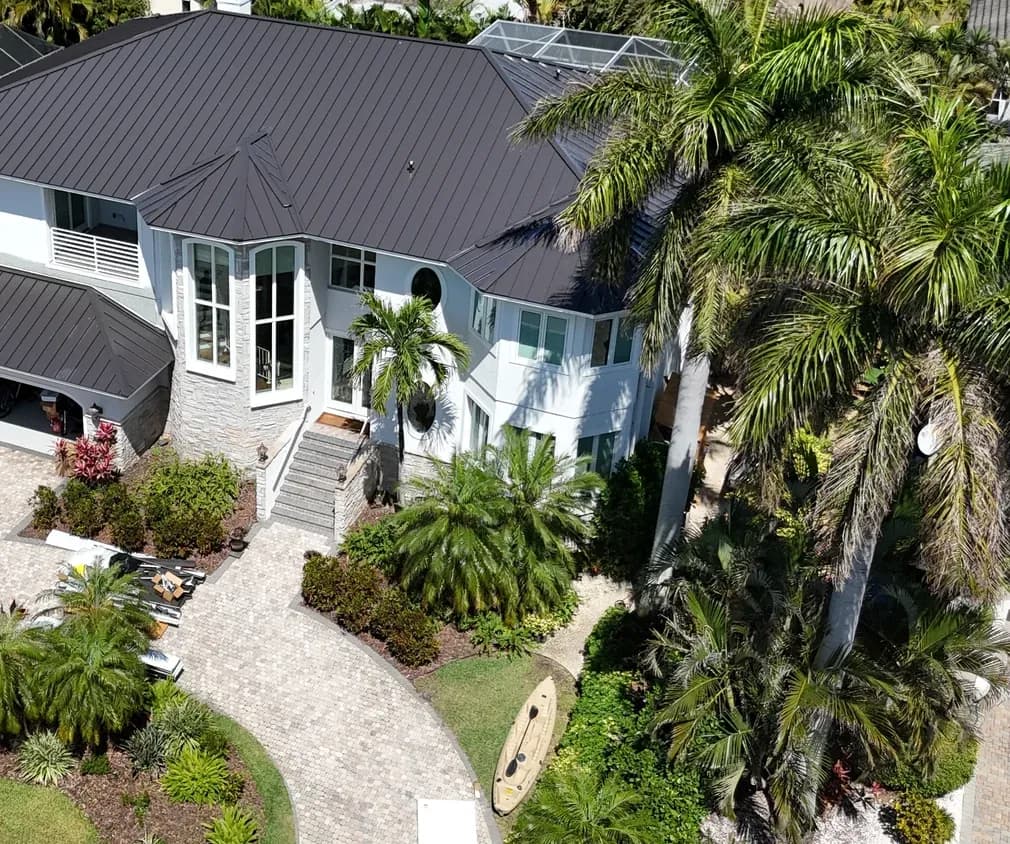
Problem. Hurricane Milton broke more than 60 tiles on this two-story waterfront home's glazed cobalt blue clay roof on October 9, 2024. The tile dated to 2001, and its high-gloss blue glaze had been out of production for two decades.
Result. Over 40,000 pounds of tile off the two-story roof with salvageable tiles hand-stacked and saved on site, a complete sheathing re-nail, a 2-ply self-adhered Polyglass system across the deck, stucco cut back so new flashing counterflashes behind it, and 1.5 inch snaplock .040 aluminum panels on 4,400 stainless steel clips rated to 176 pounds per square foot. The Certificate of Completion was signed April 6, 2026.
Decision questions
These are the conditions an inspection verifies before this assembly is worth recommending. If one fails, the recommendation changes.
Panel profile and clip selection
Thermal movement accommodation
Penetration and transition detailing
Oil-canning expectations on flat pans
FAQ
The questions owners and facility managers actually ask about this system, answered plainly.
Standing seam hides its fasteners under raised, interlocking seams, so there are no exposed screws in the field to back out and leak. The lower-cost metal roofs, often called exposed-fastener or through-fastened panels, screw straight through the metal, and those thousands of rubber-gasketed screws are a maintenance item that ages faster than the panels. They are different categories with different lives, even though both are metal.
No. Oil-canning is the slight waviness you can see in the flat of a metal panel, and it is an inherent characteristic of light-gauge metal, not a failure. A ribbed or striated profile reduces it, and it does not affect performance. It is best understood before installation so it is not a surprise afterward.
It can if the wrong metal is used or cut edges and scratches are left unprotected, which is exactly why coastal specification matters. Aluminum or a high-grade coated steel with compatible fasteners and flashings, plus cut-edge care and keeping dissimilar metals apart, is what lets a metal roof do well in salt air. The material choice is a coastal decision, not a default.
Not the way a bare metal barn is. Over a solid deck and underlayment, a residential standing seam roof is roughly as quiet as any other roof. The drumming people remember usually comes from metal installed over open framing with nothing beneath it.
No. Metal does not make a strike more likely, and because it is noncombustible, it can actually be safer than a combustible roof if lightning does strike nearby. This is a common myth with no basis in how lightning behaves.
Both can work, and the right answer depends on the exact exposure and the product approval for the wind zone. Aluminum is naturally corrosion-resistant in salt air, while high-grade coated steel offers strength and value when the coating, edges, and compatible accessories are handled correctly. An inspection and the product approval for the site settle it, not a general rule.
Keep going
Where to go next, whether you are picking a finish color, weighing metal against other systems, or planning coastal detailing.
Render manufacturer metal finishes on a photo of your own house.
Open
Weigh standing seam metal against shingle and tile on the things that decide it.
Open
A rough measurement to frame a metal budget conversation.
Open
Why seams, flashings, and penetrations decide a roof, metal included.
Open
The light upkeep that protects a metal roof's long life.
Open
System review
An inspection documents the deck, drainage, and details this decision depends on, then the options get explained against the building in plain language.