Visual atlas

Roof details that deserve a closer look

Most roofs do not fail in the middle. They fail where planes meet, where things pass through, and where water changes direction. This atlas walks those details one by one: what each does, what failure looks like from safe ground, and what a real repair includes.

Read this atlas from the ground. Binoculars beat ladders every time: wet surfaces, hidden soft spots, and gusts make roofs dangerous even for people who work on them daily. Everything below can be observed from the yard, the street, a window, or the attic hatch. If water is coming in right now, go to emergency roofing first.

The premise

Fields fail slowly. Details fail first.

Every roof has two kinds of surface. The field is the broad, repetitive expanse: shingle after shingle, or an open run of membrane. Details are everywhere the field is interrupted: a valley, a wall, a chimney, a pipe, an edge. The field is built to shed water in one direction and mostly gets to do exactly that. Details are where water is asked to turn, slow down, cross a joint between materials, or leave the roof entirely, and every one of those requests is a chance to fail.

That is why leaks concentrate at transitions and penetrations rather than in the open field, and why two roofs with identical shingles can live very different lives: the difference is detailing. It is also why a competent inspection spends most of its time at the details, and why a repair scope that never mentions flashing deserves a hard second look. The inspection question set is built to demand exactly that time.

Atlas · 01-04

Where planes and walls meet

Transitions: the places where two surfaces have to agree about where the water goes. They rarely fail loudly; they fail at a corner, a lap, a missing piece of metal.

Valleys

What it does
A valley is the internal channel where two roof planes meet. Everything both planes collect funnels through it, so a valley carries several times the water of any equally sized strip of field, moving faster and often carrying debris with it.
What failure looks like
From the ground: a worn or shiny line running down the valley, granule loss concentrated there, or debris damming the channel. From inside: ceiling stains that line up with where a valley runs overhead. Granules piling below the downspout that drains a valley are the surface wearing away exactly where the water concentrates.
What a proper repair addresses
The whole water path, rebuilt in order: the underlayment beneath the valley (an ice and water membrane where the climate calls for one), the valley metal or the woven or cut shingle detail the system uses, and laps that shed downhill. Caulk squeezed into a worn valley is not a repair. It is a delay with a deadline.

Wall and step flashing

What it does
Where a roof plane runs into a vertical wall, step flashing tucks a bent piece of metal under each shingle course and up behind the wall covering, so water crossing the joint always lands on metal. Counterflashing closes the top edge, and a kick-out at the bottom throws water into the gutter instead of behind the siding.
What failure looks like
Interior stains on the wall below the roof-to-wall line, peeling paint or dark streaks on siding just under the intersection, or a long bead of sealant where metal should show. A missing kick-out announces itself as rot at the bottom corner of the wall, sometimes years before anything shows inside.
What a proper repair addresses
Step flashing woven piece by piece into the courses, not one long bent strip and not surface sealant; counterflashing set into the wall or into a cut reglet; a kick-out at the base. Done properly this means removing some roofing and wall covering at the joint. A bid that does not include that is describing caulk.

Chimneys and saddles

What it does
A chimney interrupts the flow across the roof, and its uphill side takes the hit: water and debris pile against it. A saddle (also called a cricket), the small peaked diverter built behind the chimney, splits the flow around it. Wide chimneys need one; without it, flashing alone is asked to do too much.
What failure looks like
Stains on ceilings or walls near the chimney, rust or mortar streaks running from its base down the slope, and, visible from the yard at an angle, leaves piled behind the chimney where a saddle should be shedding them.
What a proper repair addresses
The full flashing set, not one piece of it: base flashing at the front, step flashing up the sides, the saddle behind, and counterflashing let into the masonry joints rather than smeared onto the surface. Chimney leaks are also the classic spot where a roof problem is really a masonry problem (a failed crown, porous brick), so a proper diagnosis checks both.

Ridge and hip lines

What it does
Ridges and hips are the roof's highest seams, closed with cap pieces. On many shingle roofs the ridge also works for a living: a ridge vent along it exhausts attic air as part of the ventilation path the shingle manufacturer requires.
What failure looks like
From the street, a ridge should read as a clean, straight line against the sky. Missing, lifted, or flapping caps break that line, most often after wind. From the attic: daylight at the ridge where a vent baffle should be, or water traces down the ridge framing.
What a proper repair addresses
Caps fastened and lapped to the system's specification, and, where a ridge vent is involved, a vent matched to real intake at the eaves. A leaking ridge is frequently a ventilation detail installed wrong rather than caps gone bad, which is why the fix should be specified, not guessed at.
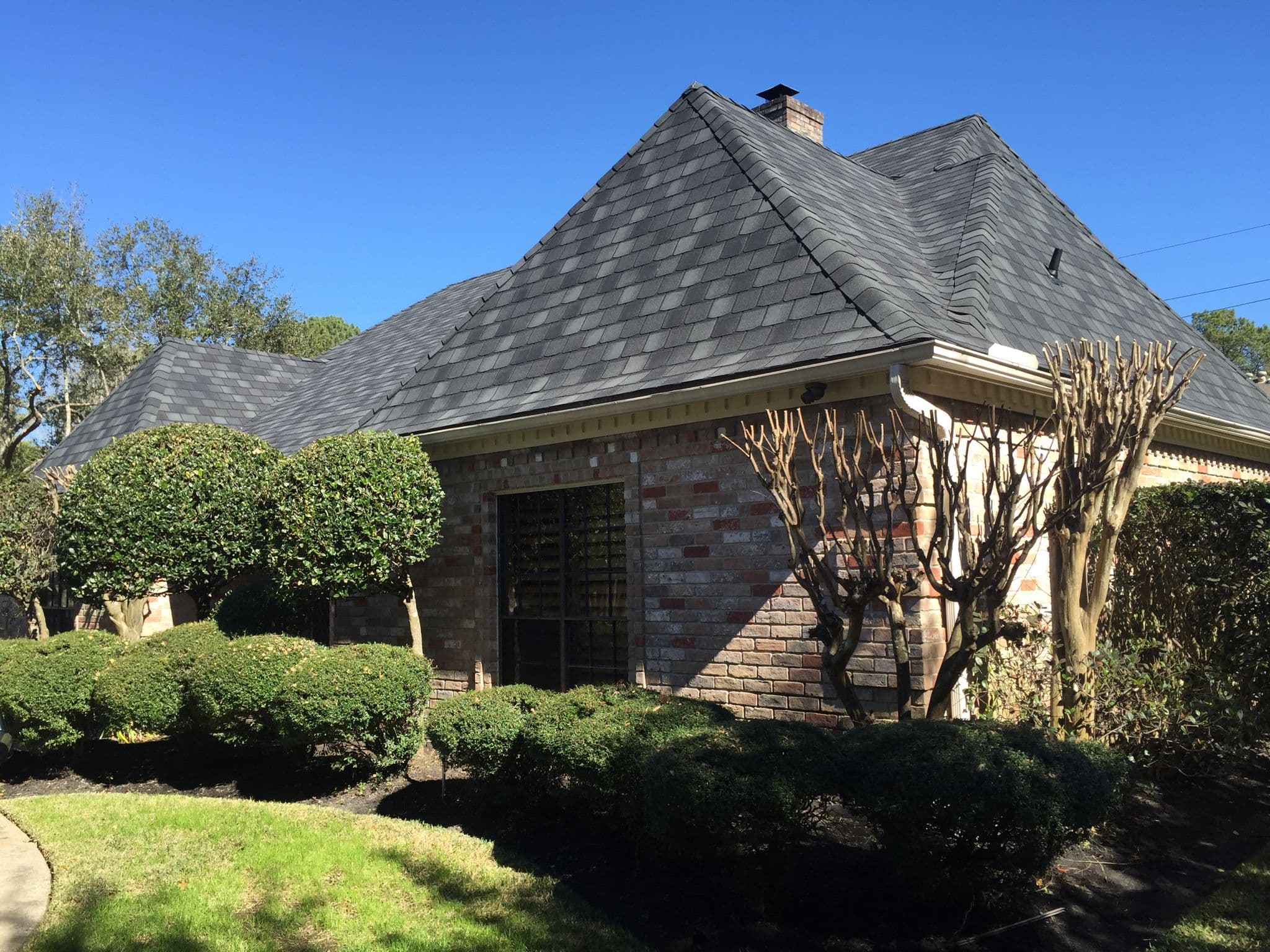
Completed dark architectural-shingle roof on a brick home
A completed architectural-shingle roof seen from the ground. The ridge at the top and the eave edge at the bottom are exactly the lines this atlas asks you to read: straight, closed, and even, with no lifted caps and no sagging edges.

Atlas · 05-06

Penetrations and openings

Every hole in a roof is intentional, engineered, and aging on its own schedule, usually a faster one than the field around it.

Penetrations: pipes, vents, and HVAC curbs

What it does
Every pipe, vent, flue, and rooftop unit is a deliberate hole in the roof, and each relies on its own small flashing system: a boot around a plumbing pipe, a flanged flashing under a vent, a raised curb with counterflashing under mechanical equipment. The field around them is only as good as these interruptions.
What failure looks like
With binoculars: cracked or split rubber pipe boots (sun destroys them years before the shingles around them fail), rust rings at vent bases, or tar smeared around anything, which marks an old shortcut. Inside: stains near where a pipe or duct passes through the ceiling. On commercial roofs, leaks that begin after an equipment service visit point at curbs and abandoned fastener holes.
What a proper repair addresses
The flashing replaced as a unit and woven back into the field, not recoated in place: a new boot under the surrounding courses, curb flashing and counterflashing rebuilt at equipment, and, on membrane roofs, a patch properly welded to clean membrane. Sealant has a place as a finishing touch. As the entire repair, it is a countdown.

Skylights

What it does
A skylight is a factory-built opening: the unit, its curb, and a flashing kit engineered for a specific roof system. When each part does its job, skylights are not the inevitable leak their reputation suggests. The reputation comes from improvised installations.
What failure looks like
Drips or stains at a skylight's lower corners after rain usually mean flashing. Fog or moisture between the panes is different: the glazing unit's own seal has failed, and no flashing repair will clear it. From inside, a stain that starts at the skylight well tells you where to look, not necessarily where the water enters.
What a proper repair addresses
The manufacturer's flashing kit for that exact unit on that exact roofing system, the curb checked for rot, and weep channels left open so the unit can drain its own condensation. On an aging unit, replacing the skylight during a reroof is the one place early replacement is usually the frugal move; opening the roof for it later costs far more.

Atlas · 07-10

Edges, exits, and standing water

A roof is judged by where its water ends up. These four details decide that, and they are where low-slope roofs in particular win or lose.

Drip edge and eaves

What it does
The drip edge is the metal that finishes the roof's lowest border, starting water cleanly into the gutter instead of letting it curl back under the edge into the fascia and deck. The eave it protects is where the roof meets everything an owner actually sees: gutters, fascia, soffit, and, in cold climates, ice.
What failure looks like
Peeling paint or soft, discolored fascia boards, staining on the soffit, water sheeting behind the gutter during rain, and, from inside the attic, darkened or spongy decking right at the eave line. In cold climates, repeat ice damming leaves its signature here first.
What a proper repair addresses
Lap order above all: edge metal and underlayment sequenced for their position so every layer sheds onto the one below it, rotten fascia and edge decking replaced rather than covered, and an ice barrier membrane at the eaves where the climate requires one. Edge metal is inexpensive. Edge rot is not.

Gutters and drainage paths

What it does
Gutters and downspouts are not trim. They are the roof's exit ramp, collecting everything the roof sheds and moving it away from the walls and foundation. A roof system is fairly judged by where its water ends up.
What failure looks like
Overflow stripes on the siding below a gutter run, runs visibly sagging or pulling off the fascia, plants growing in the trough, water still standing in it days after rain, and downspouts that quit at the foundation. Some leaks that surface at basement level never touched the roofing at all.
What a proper repair addresses
Slope corrected toward the outlets, hangers refastened into sound wood, capacity checked against the roof area feeding each run, and downspouts extended away from the building. It is the least glamorous entry in this atlas and one of the highest-return ones.

Low-slope drains and scuppers

What it does
A low-slope roof does not shed water off an edge; it delivers water to a small number of engineered exits. Interior drains carry it down through the building, scuppers pass it out through the parapet, and codes generally expect a secondary overflow path so a single clog cannot flood the roof.
What failure looks like
Ponding rings around a drain days after rain, debris matted over strainers, stains tracking down an exterior wall below a scupper, and, inside, stains that follow a drain line through the building. A roof with one clogged drain can be holding a startling amount of water, and every inch of it adds real load.
What a proper repair addresses
The drain rebuilt as an assembly: clamping ring and target flashing resealed into the membrane, strainers replaced, scupper linings and corners resealed, and the overflow path cleared and verified. Ask when the drains were last cleaned. On many commercial roofs, that answer explains the leak history by itself.

Ponding areas

What it does
Low-slope does not mean no-slope: the assembly is designed to move water to a drain or edge. A common industry benchmark treats water still standing 48 hours after rain, in drying conditions, as ponding. A pond concentrates weight, dirt, and UV-accelerated wear on one spot, and it finds whatever weakness sits beneath it.
What failure looks like
From a window or floor above: dirt rings and dark stains marking where water repeatedly sits, algae in warm seasons, and mirror-flat patches that outlast the rest of the roof's drying after rain. Inside, stains that appear only after heavy rain, never light rain, often sit below a pond that needs hours to reach the failure point.
What a proper repair addresses
The cause before the symptom: is the low spot structural deflection, crushed or displaced insulation, or drainage that was never right? Lasting fixes add slope or exits (tapered insulation, an added drain or scupper), and membrane damage under the pond gets repaired, not painted. Coating over a pond without fixing the drainage treats the evidence and leaves the cause; many coating specifications specifically limit warranty coverage in ponding areas.
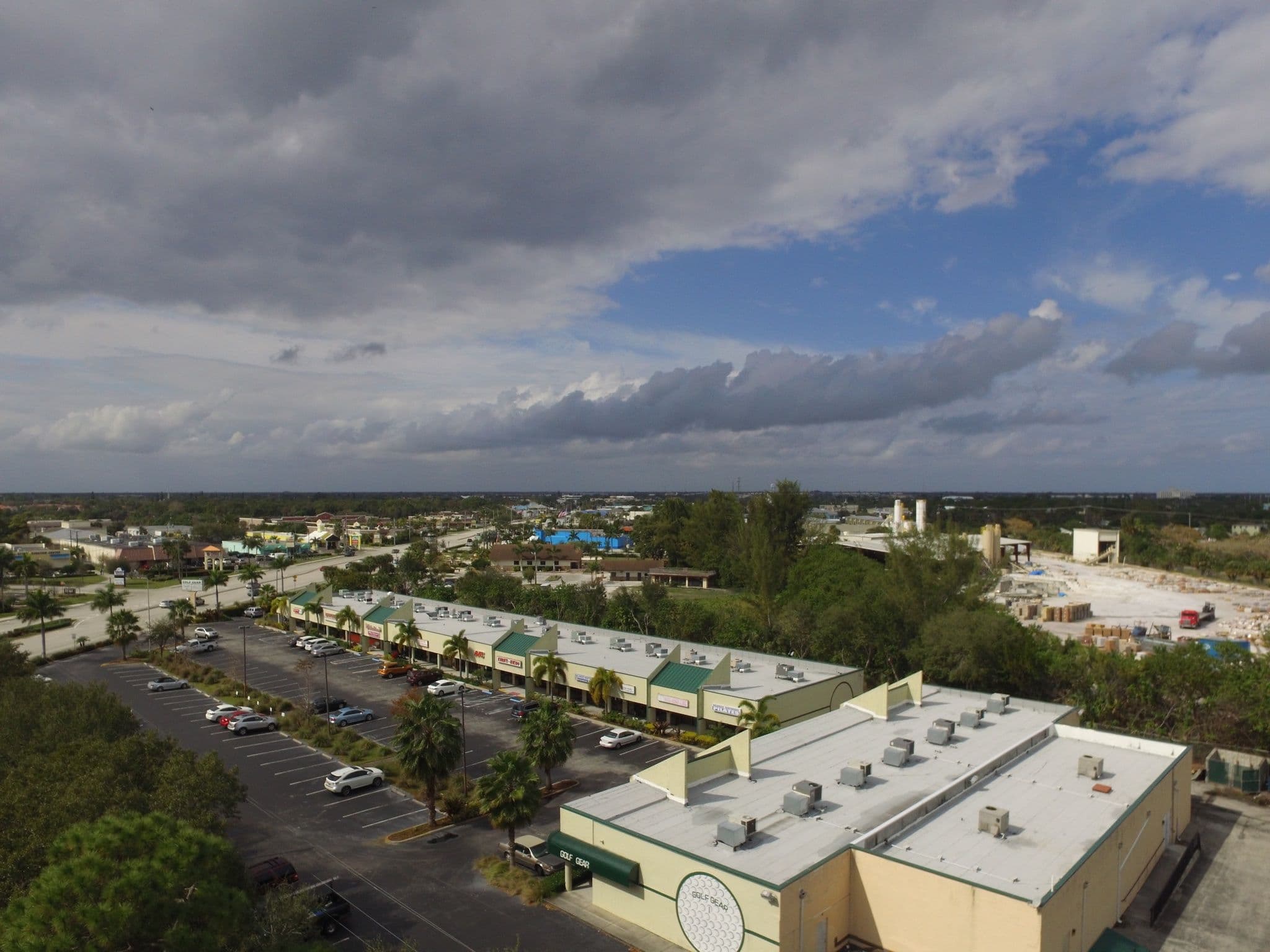
Aerial view of a commercial strip plaza with low-slope roof sections
Low-slope roof sections on a commercial plaza. Roofs like these do not shed water off an edge: everything depends on drains, scuppers, and the slope built into the assembly, none of which can be judged from the street.

Using the atlas

You are not the diagnostician. You are the client who cannot be handwaved.

Nothing here asks you to diagnose your own roof. It gives you something more useful.

When a contractor stands in your kitchen and says the word flashing, you now know what that flashing was supposed to do, what its failure looks like, and what a real repair of it includes. That changes the conversation more than any amount of technical vocabulary would. Pair each finding with the inspection question set, and when the findings add up to a bigger decision, run it through Repair, restore or replace?

How these details get rebuilt in practice is covered on the service pages: residential roof repair and commercial roof repair, with the assemblies themselves documented in the roof systems library. The rest of the guides live in the resource library.

Spotted something from the ground?

Get the detail documented before it grows.

Describe what you are seeing and where the property is located. An inspection puts a photo, a location, and a finding behind it, so the repair conversation starts from evidence.

Call now Inspection