
Emergency tarping
Active leak or storm opening? Make it safe, then call.
If anyone is in immediate danger (collapse, fire, downed power lines), call 911 before you call us.
- Stay off the roof.
Wet surfaces, hidden breaks, and gusts make a damaged roof dangerous even when it looks walkable. Assessment can wait. A fall cannot be undone.
- Keep clear of standing water near anything electrical.
If water is pooling near outlets, cords, fixtures, or a panel, keep people and pets out of the area. Cut power to that area at the breaker only if you can reach the panel from a dry spot.
- Stay out from under a sagging ceiling.
A bulging or sagging ceiling can be holding a lot of water. Keep people out of the room and do not stand beneath it.
- Contain what you can safely reach from inside.
Buckets under drips, towels at the spread, furniture and electronics moved or covered. Nothing that needs a ladder.
When you call
What to expect on the phone
Three things happen. None of them require you to know roofing terms.
The person who answers confirms the situation
You will be asked for the property location, the property type (home, commercial building, multifamily), whether water is actively entering, and whether a crew can reach the roof safely: gates, dogs, locked hatches.
You get a straight answer on what happens next
Whether and when a crew can respond depends on conditions, crew availability, and where the property is. You get told what we can commit to on that call instead of a response number we cannot keep.
The first visit aims to stop the water, not finish the roof
Emergency work is temporary mitigation: cover the opening, redirect the water, make the area safe. The permanent repair is scoped afterward, from a documented inspection done in safe, dry conditions.
Temporary mitigation is not the repair
Temporary mitigation
- Goal: stop active water entry and keep damage from spreading.
- Typical work: covering the opening, temporary seals, redirecting water.
- Limits: weather and safe access decide what a crew can do that day.
- A covered opening still needs a scoped, permanent fix.
Permanent repair
- Goal: restore the roof system, not patch the symptom.
- Based on a documented inspection in safe, dry conditions.
- Delivered as a written scope, a scheduled crew, and closeout records.
- Storm-related? The decision process is laid out at storm restoration.
Three emergency provisions
Choose the temporary protection that fits the roof
Each provision buys time: the roof is protected while the repair-versus-replacement choice gets made carefully instead of under pressure. Roof type, openings, penetrations, access, and safe working conditions determine which option fits.
Tarping
- Best when
- A storm has opened or stripped an accessible roof area and a fast temporary cover can be secured safely.
- What it provides
- A secured temporary cover over the damaged area, placed quickly after the storm.
- Time to decide
- Opens a short decision window, typically days to weeks, so the repair-versus-replacement choice is not rushed while the opening sits exposed.
Shrinkwrapping
- Best when
- Tile and metal roofs that need longer-lasting temporary protection while the permanent decision is worked through. It is what we prefer on those roofs whenever site conditions allow it.
- What it provides
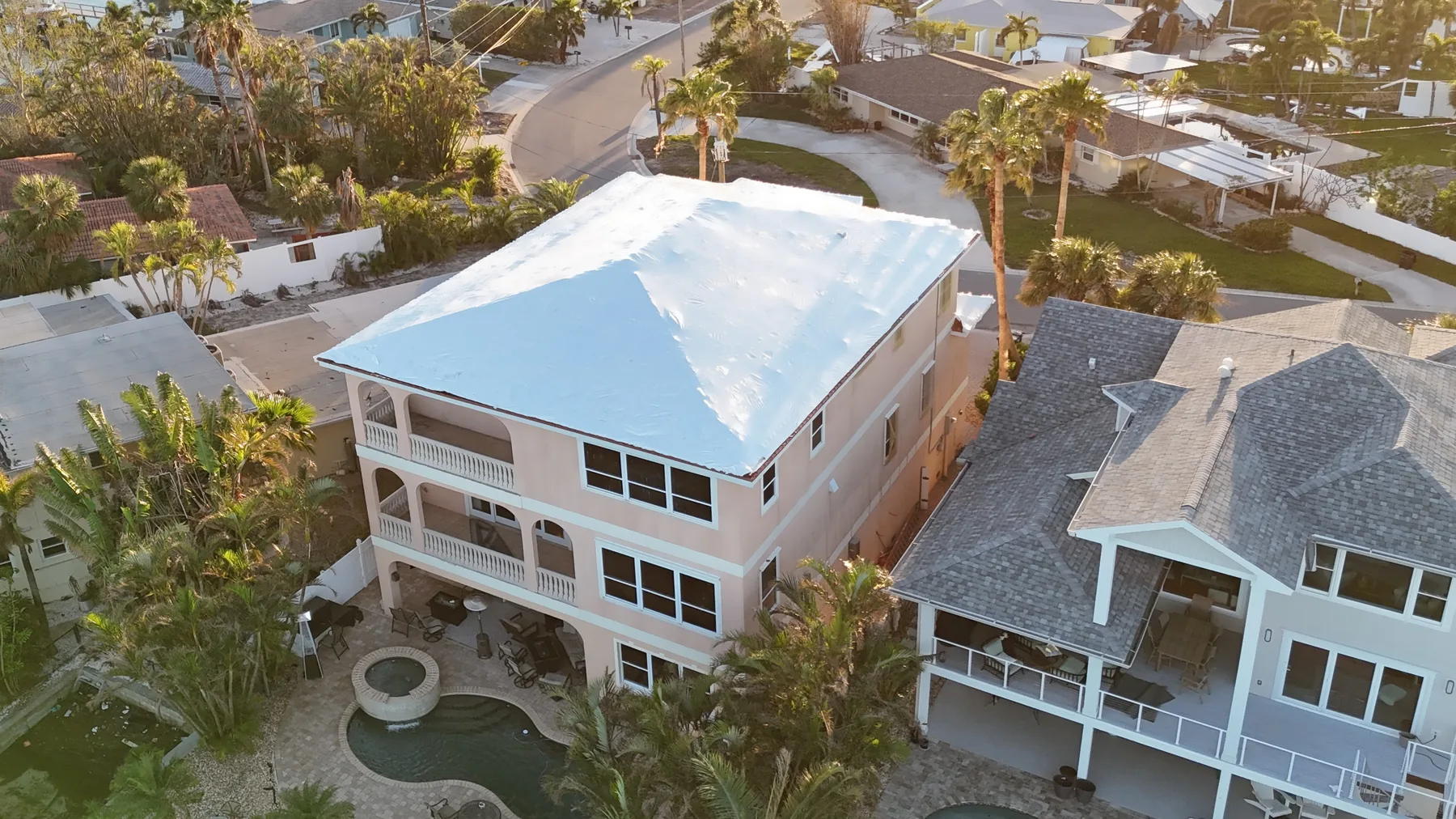
- A heat-sealed cover pulled tight over the roof, with no field penetrations holding it down. Nothing has to be re-secured every few weeks, so it holds up on the roofs a tarp keeps failing on.
- Time to decide
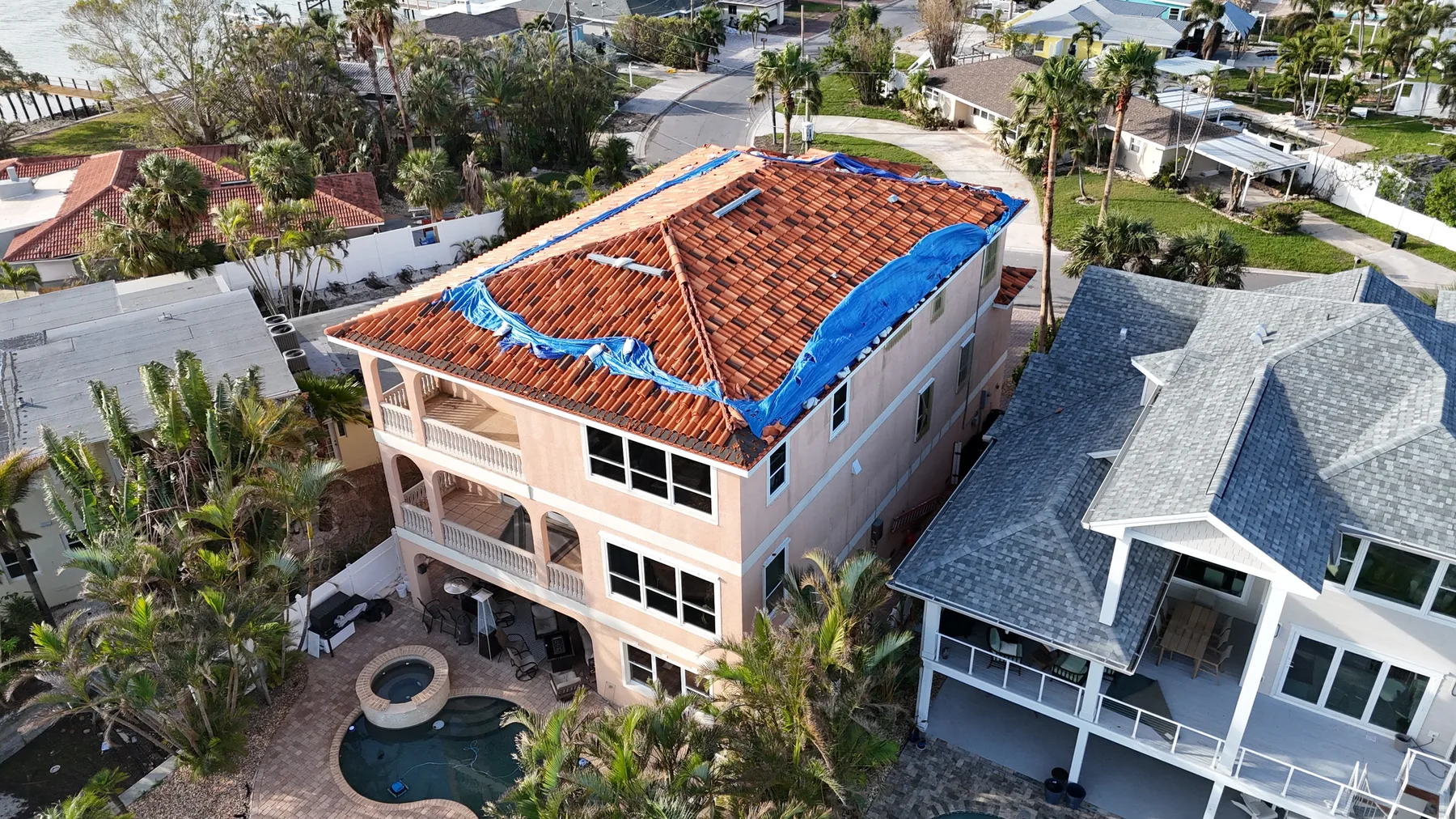
- Opens a longer decision window than a tarp. On the St. Pete Beach roof further down this page, one wrap stayed watertight for 14 months. How long a wrap holds on a given roof depends on that roof and the weather it takes, and the cost and coverage for it are quoted before the work.
Sprayfoam
- Best when
- Large commercial and industrial flat roofs so covered in penetrations and rooftop equipment that a tarp or shrinkwrap cannot seal against the roofing system. Most often needed after a major hurricane or wind event while permanent repairs are put on the schedule.
- What it provides
- K. Simon runs an enclosed sprayfoam trailer with its own engine and pump, so it works on complex commercial roofs without depending on the building's power. On a busy flat roof full of curbs, penetrations, and equipment, foam seals across the whole surface where a cover cannot. Height and feasibility for a specific building are confirmed after a site review.
- Time to decide
- Keeps the roof sealed until the permanent repair is scheduled, while limiting further interior damage across a complex flat roof.
From a real job
Fourteen months on one wrap
On a St. Pete Beach tile roof, hurricane winds shredded the emergency tarp. The shrink wrap system that replaced it stayed watertight for 14 months while the owner worked through the insurance claim: no re-tarp every few weeks, no sandbags coming off the roof, no repeated foot traffic on brittle tile. On that job the wrap ran roughly twice the cost of a full emergency tarping and outlasted it many times over, so the total spent on temporary protection came out lower. That is one roof's record, not a duration or a price we quote in advance for yours.
While you wait
What you can prepare
None of this is required to call. All of it makes the response faster and the record stronger.
Photos from safe ground.
The wet ceiling, where water is entering, the roof from the yard or the street. Never from a ladder, and never from the roof.
When it started.
The date and time you noticed it, and what the weather was doing: during the storm, hours after, or slowly over days.
Access notes.
Gate codes, a locked roof hatch or mechanical room, pets on the property, the best door to knock on.
Who can say yes.
For a commercial or multifamily building: the person who can authorize work and how to reach them.
Two separate tracks
Emergency work and insurance are not the same decision
Stopping the water is a construction decision you make now. Whether the event is covered is a policy question between you and your insurer.
Our part is the construction record: the conditions we find, the mitigation work performed, and the dates, documented with photos. That record describes what happened to the building, and it is useful in any later conversation, including one with your insurer.
What we do not do: predict coverage, promise claim outcomes, or tell you whether to file. Your policy and your insurer determine coverage; nothing about emergency mitigation changes that.
Still urgent
Water still coming in?
Not an active emergency? After a hail or wind event, start at storm restoration. For everything else, start with a documented roof inspection or browse roofing services.
For property managers, associations, and building owners
Do you have a storm plan?
The Storm Response Playbook covers the first 2 hours through day 30: documentation, mitigation, vendor verification, and the records that survive the season. Free, with a printable toolkit of eight working documents. Use it whether or not you ever call us.